

New Conversation
We typically reply in a few minutes
A hemoglobin test reveals how much hemoglobin is in a person's blood, helping to diagnose and monitor anemia and polycythemia vera. Hemoglobin is a protein inside red blood cells that carries oxygen t...
This profile includes 30 tests. Compare prices from 2 NABL-certified labs and book with the one that fits your budget.
Fasting is not required for this profile.
Each test below is collapsed for easy browsing. Click to expand.
A hemoglobin test reveals how much hemoglobin is in a person's blood, helping to diagnose and monitor anemia and polycythemia vera. Hemoglobin is a protein inside red blood cells that carries oxygen throughout the body. A hemoglobin test is done when a person is ill or during a general physical examination. Good health requires an adequate amount of hemoglobin. The amount of oxygen in the body tissues depends on how much hemoglobin is in the red cells. Without enough hemoglobin, the tissues lack oxygen and the heart and lungs must work harder to try to compensate. If the test indicates a "less than" or "greater than" normal amount of hemoglobin, the cause of the decrease or increase must be discovered. A low hemoglobin usually means the person has anemia. Anemia results from conditions that decrease the number or size of red cells, such as excessive bleeding, a dietary deficiency, destruction of cells because of a transfusion reaction or mechanical heart valve, or an abnormally formed hemoglobin.A high hemoglobin may be caused by polycythemia vera, a disease in which too many red blood cells are made.
Haemoglobin %
Anemia
Anemia-fatique, weakness, pale skin, shortness of breath, chest pain, dizziness, cognitive problem, headache, cold hands and feet.
A platelet count is a diagnostic test that determines the number of platelets in the patient's blood. Platelets, which are also called thrombocytes, are small disk-shaped blood cells produced in the bone marrow and involved in the process of blood clotting. There are normally between 150,000-450,000 platelets in each microliter of blood. Low platelet counts or abnormally shaped platelets are associated with bleeding disorders. High platelet counts sometimes indicate disorders of the bone marrow. The primary functions of a platelet count are to assist in the diagnosis of bleeding disorders and to monitor patients who are being treated for any disease involving bone marrow failure. Patients who have leukemia, polycythemia vera, or aplastic anemia are given periodic platelet count tests to monitor their health. It is a part of Complete Blood Count. It is always advisable to go for complete profile, as level of each test in profile are considered while making decision on diagnosis as well as monitoring the treatment.
Platelet Count
Hepatitis, HIV, Measles, Leukemia, Lymphoma, Cirrihosis of liver, Dengue Fever.
Bleeding Disorder-Bleeding into joints, Excessive Bruising, Heavy Bleeding, Heavy Menstrual Bleeding, Nose bleed HIV-Frequent Fever and sweats, Weight loss, Weakness, Persistent skin rashes, Short term memory loss,Mouth, genital or anal sores from herpes infection. Leukemia-Fever or chills, Persistent Fatique, frequent losing weight, Swollen Lymph nodes, Easy bleeding, Recurrent Nose bleeds, Excessive Sweating, Bone Pain or Tenderness. Dengue Fever-Fever, Headache, severe joint or muscle pain, Nausea, Vomiting, Skin Rash, Mild Bleeding. Cirrihosis of liver-loss of appetite, fatique, weight loss, swelling in ankles & legs, blood in stool, fever. Measles-High Tempreature, Small white sores, Dry cough, Tiredness, Cough,Aches, Pain.
A blood test that measures the proportion of red blood cells (similar to hematocrit).
Packed Cell Volume
Red Blood Cell Count
RBC Count (Red Blood Cell Count) measures the number of red blood cells in your blood. Red blood cells carry oxygen from your lungs to the rest of your body.
Total Leucocyte Count (TLC)—also called WBC Count (White Blood Cell Count)—measures the total number of white blood cells in your blood.
Total Leucocyte Count (TLC)—also called WBC Count (White Blood Cell Count)—measures the total number of white blood cells in your blood.
Neutrophils are usually reported as a percentage (%) of total WBC count:
Neutrophils are usually reported as a percentage (%) of total WBC count:
Bacterial infections Inflammation Stress, exercise Smoking Certain medications (e.g., steroids) Injury, surgery Rarely: blood disorders (e.g., leukemia)
Viral infections (dengue, hepatitis, flu) Bone marrow suppression Vitamin B12 or folate deficiency Autoimmune diseases Chemotherapy / certain drugs Severe infections
Lymphocytes
Lymphocytes are a type of white blood cell (WBC) that play a major role in your body’s immune system, especially in fighting viral infections and building long‑term immunity.
Acute viral infections (initial phase) Nutritional deficiency (protein, zinc) Autoimmune disease Steroid medications Stress Severe infections Rare: immune deficiency disorders
Measures if red blood cells are too small (microcytic), too large (macrocytic), or normal size (normocytic), which helps identify the cause of anemia
measures the average amount of hemoglobin (Hb) in each red blood cell (RBC), typically expressed in picograms (pg)
measures the average concentration or concentration-to-volume ratio of hemoglobin within a red blood cell, expressed in g/dL or g/L
a direct, absolute measurement (in femtoliters, fL) of the variation in red blood cell (RBC) volume, calculated at the 20% height level of the RBC size distribution histogram.
a laboratory metric measuring the variation in volume and size (anisocytosis) of red blood cells, expressed as a percentage
a blood test that measures the percentage of each type of white blood cell (WBC)—neutrophils, lymphocytes, monocytes, eosinophils, and basophils—in the body
This test measures the actual number of basophils, a type of white blood cell, per microliter of blood. It helps identify allergic reactions, chronic inflammation, or rare blood disorders by evaluating your immune system's response.
This test measures the total number of monocytes, the "scavenger" white blood cells that fight chronic infections and remove damaged tissue. High levels often indicate that the body is dealing with long-term inflammation, a viral infection, or an immune disorder.
Immature Granulocytes (IG) are early-stage white blood cells that normally develop inside the bone marrow. Their presence in the bloodstream usually indicates the body is actively responding to an infection, inflammation, or bone marrow stress.
The Immature Granulocyte Percentage (IG%) represents the proportion of young, developing white blood cells relative to the total white blood cell count. A higher percentage typically signals that your immune system is "releasing the troops" early to fight an active infection or inflammation.
The Total Leucocytes Count (WBC) measures the total number of white blood cells in your blood to evaluate your overall immune health. It is primarily used to detect the presence of infections, inflammation, or medical conditions that affect the bone marrow.
Mean Platelet Volume (MPV) measures the average size of the platelets in your blood, which helps determine how quickly your body is producing them. Larger platelets are typically younger and more active, often indicating that the bone marrow is rapidly releasing new ones to replace those lost or used.
Nucleated Red Blood Cells (NRBC) are immature red blood cells that are normally only found in the bone marrow of adults. Their appearance in the bloodstream can signal that the body is under significant stress, such as severe anemia or a lack of oxygen.
The Nucleated Red Blood Cells Percentage (NRBC%) measures the ratio of immature, nucleus-containing red blood cells to the total number of white blood cells. In healthy adults, this percentage should typically be zero, as their presence in the blood often indicates an urgent demand for new cells due to severe anemia or oxygen deprivation.
Plateletcrit (PCT) measures the total volume of platelets in your blood, representing the percentage of blood occupied by these clotting cells. It provides a more comprehensive view of your clotting capacity by combining both the number and the size of your platelets.
Hematocrit (PCV) measures the percentage of your total blood volume that is made up of red blood cells. It is a key indicator used to check for conditions like anemia (too few cells) or polycythemia (too many cells).
Platelet Distribution Width (PDW) measures how much your platelets vary in size, indicating whether they are mostly uniform or have significant differences. A high PDW suggests that your bone marrow is releasing new, larger platelets, often as a response to the body using up or losing platelets quickly.
Platelet Large Cell Ratio (P-LCR) measures the percentage of large-sized platelets circulating in your blood stream. A higher ratio typically indicates increased platelet production and activity, often occurring when the bone marrow is replacing lost or used platelets.
This test measures the total number of neutrophils, the primary white blood cells responsible for fighting bacterial infections. It is a key indicator of how well your immune system is responding to acute stress, infection, or physical injury.
Basophils are a type of white blood cell measured in a Complete Hemogram to identify allergic reactions, inflammatory conditions, or potential bone marrow disorders. As part of your immune system's "first responder" team, they release enzymes like histamine to help defend the body against allergens and parasites.
Eosinophils are specialized white blood cells primarily responsible for fighting parasitic infections and playing a key role in the body's response to allergic diseases and asthma. A measurement of these cells helps doctors identify inflammatory conditions, underlying allergies, or specific immune system reactions.
Monocytes are the largest type of white blood cell, acting as "scavengers" that circulate in the blood before moving into tissues to ingest bacteria and debris. They play a critical role in the immune system by presenting fragments of pathogens to other immune cells to trigger a more targeted defense.
The Lymphocytes Absolute Count measures the actual number of these white blood cells in a microliter of blood, providing a more precise view of immune health than a simple percentage. This specific metric helps doctors diagnose viral infections, evaluate immune system function, and monitor chronic conditions like leukemia or autoimmune disorders.
Select city to view labs/clinics.
✅ Free home sample collection in all cities
✅ NABL & NABH certified lab partners
✅ Full refund if cancelled before sample collection
✅ Reports delivered on WhatsApp & Email
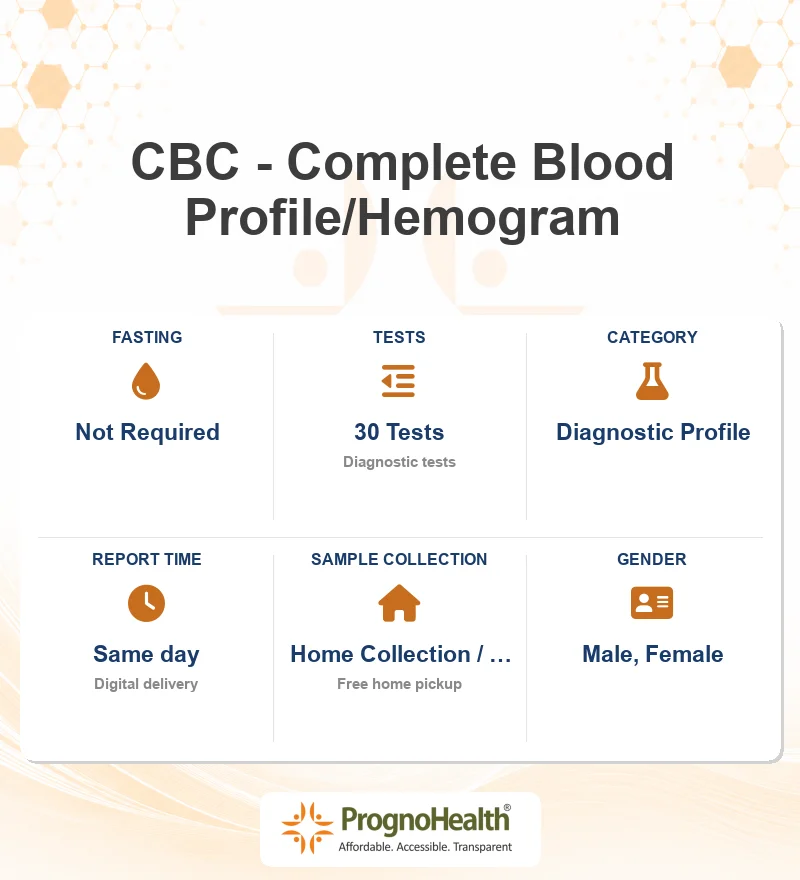
The CBC - Complete Blood Profile/Hemogram is a diagnostic profile package comprising 30 tests designed for male, female. It helps in early detection and monitoring of health conditions through a comprehensive set of diagnostic tests. Book from NABL-certified labs starting at just ₹330.
A hemoglobin test reveals how much hemoglobin is in a person's blood, helping to diagnose and monitor anemia and polycythemia vera. Hemoglobin is a protein inside red blood cells that carries oxygen throughout the body. A hemoglobin test is done when a person is ill or during a general physical examination. Good health requires an adequate amount of hemoglobin. The amount of oxygen in the body tissues depends on how much hemoglobin is in the red cells. Without enough hemoglobin, the tissues lack...
Anemia Hepatitis, HIV, Measles, Leukemia, Lymphoma, Cirrihosis of liver, Dengue Fever. Bacterial infections Inflammation Stress, exercise Smoking Certain medications (e.g., steroids) Injury, surgery Rarely: blood disorders (e.g., leukemia)
Anemia-fatique, weakness, pale skin, shortness of breath, chest pain, dizziness, cognitive problem, headache, cold hands and feet. Bleeding Disorder-Bleeding into joints, Excessive Bruising, Heavy Bleeding, Heavy Menstrual Bleeding, Nose bleed HIV-Frequent Fever and sweats, Weight loss, Weakness, Persistent skin rashes, Short term memory loss,Mouth, genital or anal sores from herpes infection....
Step 1: Choose your preferred NABL-certified lab and select your appointment date.
Step 2: A trained phlebotomist visits your home at your chosen time for sample collection — completely free.
Step 3: Receive your detailed digital reports within Same day, 1 Day on WhatsApp and email.
This profile follows ICMR (Indian Council of Medical Research) guidelines for diagnostic testing. All tests are conducted at NABL and NABH accredited laboratories with internationally calibrated equipment.
Medically reviewed by the PrognoHealth Clinical Advisory Team
Verified reviews from customers who booked CBC - Complete Blood Profile/Hemogram with PrognoHealth.
Everything you need to know about CBC - Complete Blood Profile/Hemogram.
Cost free sample pickup from Home or Office.
Cancel before collection — full refund within 24 hours.
Reschedule appointment — no charges levied.
 A-Z Diseases
 Corporate Health & Wellness