

New Conversation
We typically reply in a few minutes
The blood urea nitrogen (BUN) test measures the level of urea nitrogen in a sample of the patient's blood. Urea is a substance that is formed in the liver when the body breaks down protein. Urea then...
This profile includes 7 tests. Compare prices from 2 NABL-certified labs and book with the one that fits your budget.
Fasting of 10–12 Hours fasting required, Not Required, Required is required for this profile.
Each test below is collapsed for easy browsing. Click to expand.
The blood urea nitrogen (BUN) test measures the level of urea nitrogen in a sample of the patient's blood. Urea is a substance that is formed in the liver when the body breaks down protein. Urea then circulates in the blood in the form of urea nitrogen. In healthy people, most urea nitrogen is filtered out by the kidneys and leaves the body in the urine. If the patient's kidneys are not functioning properly or if the body is using large amounts of protein, the BUN level will rise. If the patient has severe liver disease, the BUN will drop.
Blood Urea Nitrogen (BUN)
kidney Disease
Nausea, Vomiting, loss of appetite, sleep problem, changes in urine output, swelling of feet.
Creatinine test is a laboratory test used to measure level of creatinine in blood. Creatinine is a waste product that is produced continuously during normal muscle breakdown. The kidneys filter creatinine from the blood into the urine, and reabsorb almost none of it. Serum creatinine is widely used as a test of renal function both as a general screen, along with urine protein, for renal disease, and as a test for serial monitoring of renal function. When the kidneys are functioning normally, the serum creatinine level should remain constant and normal. Slight increases in creatine levels can appear after meals, especially after ingestion of large quantities of meat, and some diurnal variation may occur, with a low point at 7 A.M. and a peak at 7 P.M. Serious renal disorders, such as glomerulonephritis, pyelonephritis, and urinary obstruction, will cause abnormal elevations. The creatinine level is interpreted in conjunction with another kidney function test called the Blood Urea Nitrogen (BUN). The serum creatinine level has much the same significance as the BUN but tends to rise later. Because of this, determinations of creatinine help to chronicle a disease process. Generally, a doubling of creatinine suggests a 50% reduction in kidney filtration rate.
Creatinine
Kidney Disease
Nausea, Vomiting, loss of appetite, sleep problem, changes in urine output, swelling of feet.
This test measures the amount of calcium in blood. It is used to evaluate parathyroid function and calcium metabolism . It is used to monitor patients with renal failure, renal transplantation, hyperparathyroidism, and various malignancies, as well as to monitor calcium levels during and after large-volume blood transfusions. Calcium helps build strong bones and teeth. It is important for heart function, and helps with muscle contraction, nerve signaling, and blood clotting. It is a part of Kidney Function Test. It is always advisable to go for complete profile, as level of each test in profile are considered while making decision on diagnosis as well as monitoring the treatment.
Calcium
Chronic Kidney Disease,Chronic Liver Disease
Chronic Kidney Disease-Nausea, Vomiting, loss of appetite, sleep problem, changes in urine output, swelling of feet. Chronic Liver Disease-Abdominal pain, swelling in legs, Dark urine color, eyes and skin appears.
Uric acid tests are tests that are done to measure the levels of uric acid in blood serum or in urine. The uric acid tests are used to evaluate the blood levels of uric acid for gout and to assess uric acid levels in the urine for kidney stone formation. The urine test is used most often to monitor patients already diagnosed with kidney stones, but it can also be used to detect disorders that affect the body's production of uric acid and to help measure the level of kidney functioning. Uric acid is a waste product that results from the breakdown of purine, a nucleic acid. (Nucleic acids are the building blocks of DNA.) Uric acid is made in the liver and excreted by the kidneys. If the liver produces too much uric acid or the kidneys excrete too little, the patient will have too much uric acid in the blood. This condition is called hyperuricemia. Supersaturated uric acid in the urine (uricosuria) can crystallize to form kidney stones that may block the tubes that lead from the kidneys to the bladder (the ureters).
Uric Acid
Gout ,Kidney Disease
Nausea, Vomiting, loss of appetite, sleep problem, changes in urine output, swelling of feet
The BUN / Sr. Creatinine Ratio measures the ratio of blood urea nitrogen to serum creatinine
Urea (calculated) refers to the concentration of urea in serum, plasma, or urine derived from laboratory measurements of Blood Urea Nitrogen (BUN)
compares blood urea to creatinine to evaluate kidney function and distinguish between prerenal causes (e.g., dehydration, heart failure) and intrinsic kidney damage
Select city to view labs/clinics.
✅ Free home sample collection in all cities
✅ NABL & NABH certified lab partners
✅ Full refund if cancelled before sample collection
✅ Reports delivered on WhatsApp & Email
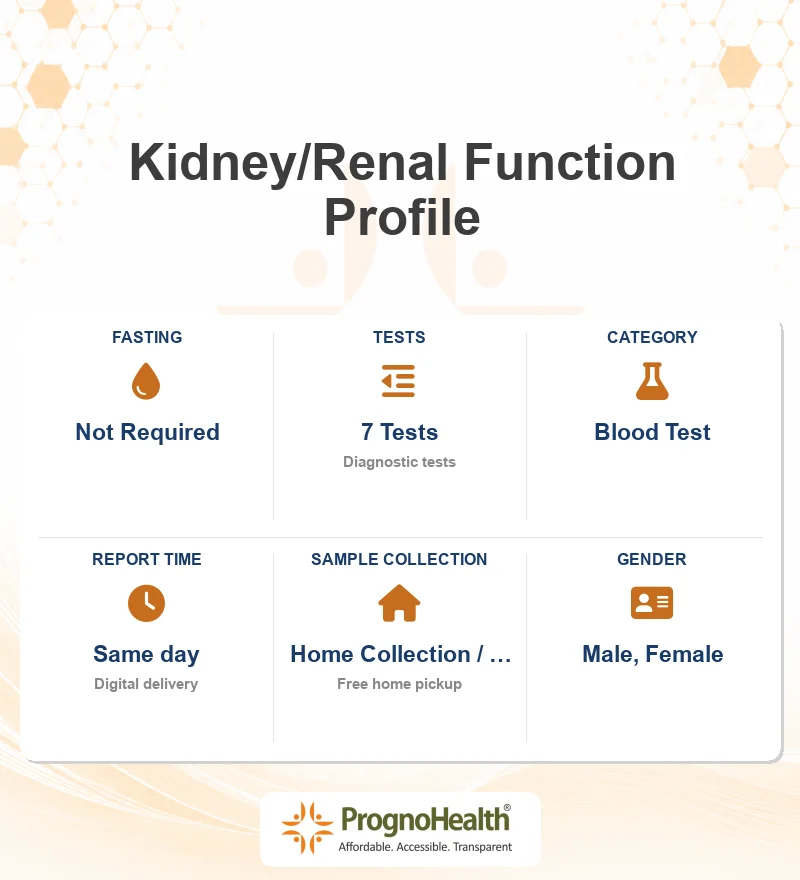
The Kidney/Renal Function Profile is a blood test package comprising 7 tests designed for male, female. It helps in early detection and monitoring of health conditions through a comprehensive set of diagnostic tests. Book from NABL-certified labs starting at just ₹880.
The blood urea nitrogen (BUN) test measures the level of urea nitrogen in a sample of the patient's blood. Urea is a substance that is formed in the liver when the body breaks down protein. Urea then circulates in the blood in the form of urea nitrogen. In healthy people, most urea nitrogen is filtered out by the kidneys and leaves the body in the urine. If the patient's kidneys are not functioning properly or if the body is using large amounts of protein, the BUN level will rise. If the patient...
kidney Disease Kidney Disease Chronic Kidney Disease,Chronic Liver Disease Gout ,Kidney Disease
Nausea, Vomiting, loss of appetite, sleep problem, changes in urine output, swelling of feet. Nausea, Vomiting, loss of appetite, sleep problem, changes in urine output, swelling of feet. Chronic Kidney Disease-Nausea, Vomiting, loss of appetite, sleep problem, changes in urine output, swelling of feet. Chronic Liver Disease-Abdominal pain, swelling in legs, Dark urine col...
Step 1: Choose your preferred NABL-certified lab and select your appointment date.
Step 2: A trained phlebotomist visits your home at your chosen time for sample collection — completely free.
Step 3: Receive your detailed digital reports within 1 Day, Same day on WhatsApp and email.
This profile follows ICMR (Indian Council of Medical Research) guidelines for diagnostic testing. All tests are conducted at NABL and NABH accredited laboratories with internationally calibrated equipment.
Medically reviewed by the PrognoHealth Clinical Advisory Team
Verified reviews from customers who booked Kidney/Renal Function Profile with PrognoHealth.
Everything you need to know about Kidney/Renal Function Profile.
Cost free sample pickup from Home or Office.
Cancel before collection — full refund within 24 hours.
Reschedule appointment — no charges levied.
 A-Z Diseases
 Corporate Health & Wellness