

New Conversation
We typically reply in a few minutes
This test is used to detect abnormal blood chloride levels in order to monitor a variety of health condition high blood pressure, heart failure, kidney disease, or liver disease. These conditions can...
This profile includes 3 tests. Compare prices from 1 NABL-certified labs and book with the one that fits your budget.
Fasting is not required for this profile.
Each test below is collapsed for easy browsing. Click to expand.
This test is used to detect abnormal blood chloride levels in order to monitor a variety of health condition high blood pressure, heart failure, kidney disease, or liver disease. These conditions can cause an electrolyte imbalance. It is performed along with other electrolyte tests to indicate the patient's acid-base balance and hydrational status. Electrolyte panels or basic metabolic panels are commonly used to monitor treatment of certain problems, including high blood pressure (hypertension), heart failure, and liver and kidney disease.
Chloride
Heart failure, kidney disease, or liver disease.
Heart disease-Chest pain, Breathlessness, pain, numbness, weakness in arms and legs, pain in the neck, jaw and throat, pale grey or blue skin color,swelling in legs. Liver disease-Abdominal pain,swelling in legs,Dark urine color,eyes and skin appears yellow,nausea,fatique,diarhea,clubbed fingers kidney disease- Nausea,Vomiting,loss of appetite,sleep problem,changes in urine output,swelling of feet
A potassium test is used to measure the amount of potassium in your blood. It is used to detect concentrations that are too high (hyperkalemia) or too low (hypokalemia). High serum potassium (hyperkalemia) occurs at potassium levels above 5.0 mM; it is considered severe over 8.0 mM. Hyperkalemia is relatively uncommon, but sometimes occurs in patients with kidney failure who take potassium supplements. Hyperkalemia can result in abnormal beating of the heart (cardiac arrhythmias). Low serum potassium (hypokalemia) occurs when serum potassium falls below 3.0 mM. It can result from low dietary potassium, as during starvation or in patients with anorexia nervosa; from excessive losses via the kidneys, as caused by diuretic drugs; or by diseases of the adrenal or pituitary glands. Mild hypokalemia causes muscle weakness, while severe hypokalemia can cause paralysis, the inability to breathe, and cardiac arrhythmias.The most common cause of hyperkalemia is kidney disease. Hypokalemia can occur if someone has diarrhea and vomiting or if is sweating excessively. It is a part of electrolyte panel. This test is usually ordered together with other electrolytes to get the better picture of underlying disorder.
Potassium
Kidney Disease
Kidney disease-Nausea, Vomiting, loss of appetite, sleep problem, changes in urine output, swelling of feet. Liver disease-Abdominal pain, swelling in legs, Dark urine color, eyes and skin appears yellow, nausea, fatique, diarrhea, clubbed fingers.
This test measures the amount of sodium (salt) in blood. Sodium testing is a part of the routine lab evaluation of most patients. It is one of the blood electrolytes, which are often ordered as a group. The most common group of blood electrolytes is sodium, potassium, chloride, and bicarbonate (total CO2). These electrolytes are also included in the basic metabolic panel, a larger group of tests widely used when someone has non-specific health complaints. High serum sodium levels (hypernatremia) occur at sodium concentrations over 145 mM, with severe hypernatremia over 152 mM. Hypernatremia is usually caused by diseases that cause excessive urination. In these cases, water is lost, but sodium is still retained in the body. The symptoms include confusion and can lead to convulsions and coma. Low serum sodium levels (hyponatremia) are below 130 mM, with severe hyponatremia at or below 125 mM. Hyponatremia often occurs with severe diarrhea, with losses of both water and sodium, but with sodium loss exceeding water loss. Hyponatremia provokes clinical problems only if serum sodium falls below 125 mM, especially if this has occurred rapidly. The symptoms can be as mild as tiredness but may lead to convulsions and coma.
Sodium
Hyponatremia,Hypernatremia,Dehydration,Renal disorders,Electrolyte imbalance
Weakness,Confusion,Headache,Nausea,Seizures
Select city to view labs/clinics.
✅ Free home sample collection in all cities
✅ NABL & NABH certified lab partners
✅ Full refund if cancelled before sample collection
✅ Reports delivered on WhatsApp & Email
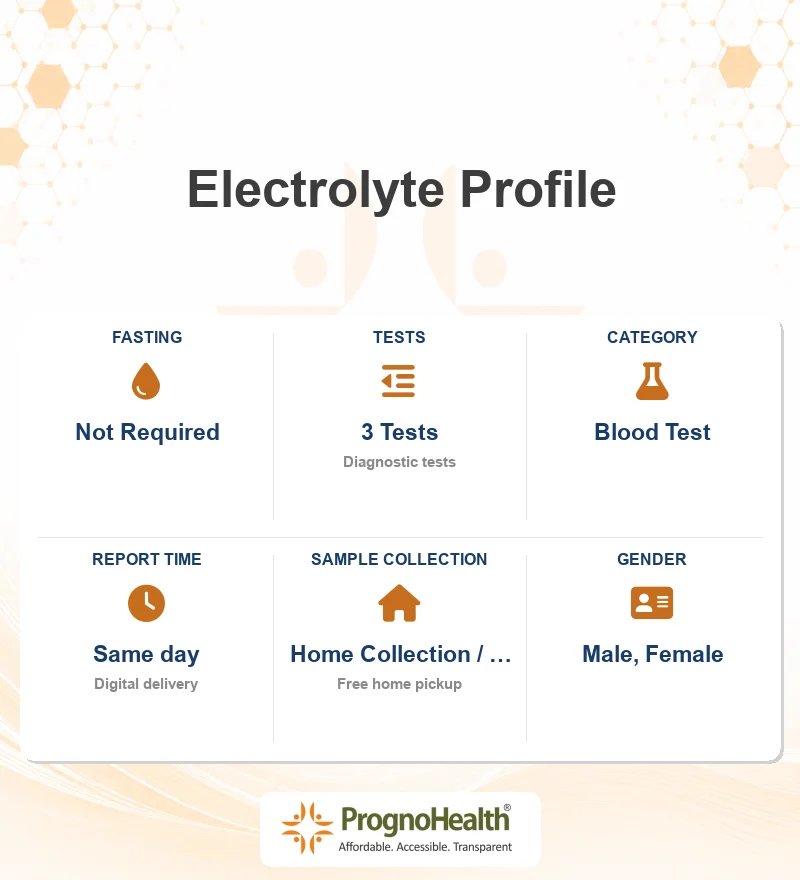
The Electrolyte Profile is a blood test package comprising 3 tests designed for male, female. It helps in early detection and monitoring of health conditions through a comprehensive set of diagnostic tests. Book from NABL-certified labs starting at just ₹470.
This test is used to detect abnormal blood chloride levels in order to monitor a variety of health condition high blood pressure, heart failure, kidney disease, or liver disease. These conditions can cause an electrolyte imbalance. It is performed along with other electrolyte tests to indicate the patient's acid-base balance and hydrational status. Electrolyte panels or basic metabolic panels are commonly used to monitor treatment of certain problems, including high blood pressure (hypertension)...
Heart failure, kidney disease, or liver disease. Kidney Disease Hyponatremia,Hypernatremia,Dehydration,Renal disorders,Electrolyte imbalance
Heart disease-Chest pain, Breathlessness, pain, numbness, weakness in arms and legs, pain in the neck, jaw and throat, pale grey or blue skin color,swelling in legs. Liver disease-Abdominal pain,swelling in legs,Dark urine color,eyes and skin appears yellow,nausea,fatique,diarhea,clubbed fingers kidney d...
Step 1: Choose your preferred NABL-certified lab and select your appointment date.
Step 2: A trained phlebotomist visits your home at your chosen time for sample collection — completely free.
Step 3: Receive your detailed digital reports within 1 Day on WhatsApp and email.
This profile follows ICMR (Indian Council of Medical Research) guidelines for diagnostic testing. All tests are conducted at NABL and NABH accredited laboratories with internationally calibrated equipment.
Medically reviewed by the PrognoHealth Clinical Advisory Team
Verified reviews from customers who booked Electrolyte Profile with PrognoHealth.
Everything you need to know about Electrolyte Profile.
Cost free sample pickup from Home or Office.
Cancel before collection — full refund within 24 hours.
Reschedule appointment — no charges levied.
 A-Z Diseases
 Corporate Health & Wellness